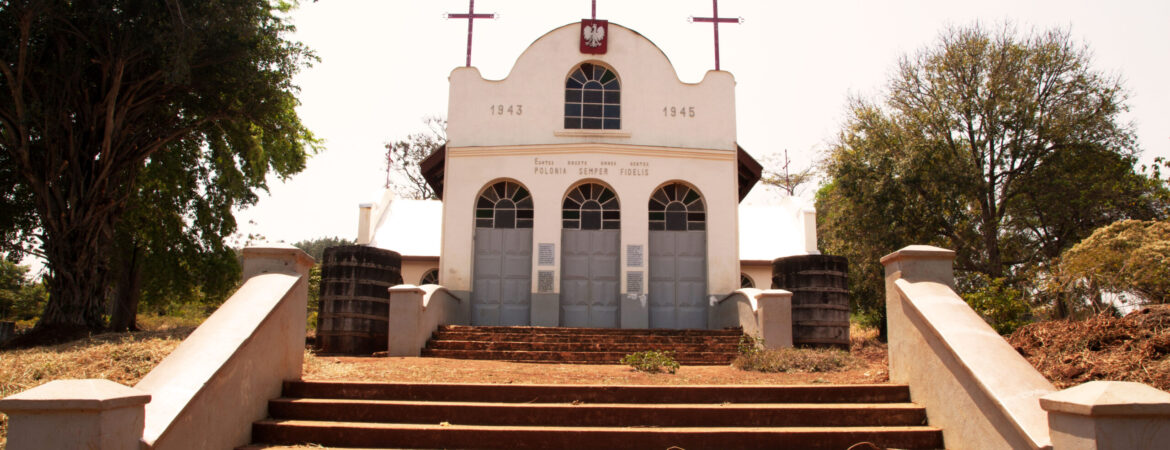
Also known as our Lady Queen of Poland Catholic Church in Uganda, this polish church is located in Nyabyeya near Masindi district. It was constructed in the middle of 1943 and 1945 by refugees who traced their origin from Poland and sought refuge in that area. The church was constructed at a mountain known as Wanda Mountain and words in four different languages are inscribed on the church that is; Kiswahili, English, Latin and Polish.
The church is unique in its own way, it was constructed as a special dedication to the then Queen of Polish, named Blessed Virgin Mary. This was done by the refugees and exiles who were wandering to the free father land. They designed the polish coat of arms and words and inscribed them at the church’s entrance. The words inscribe at the entrance read “Poloniae semper Fidelis.” Inside the church other words are inscribed and they are different from those written out side. These ones are written below the icon of Our Lady of Czestochowa and Stations of the Cross. This was serving people from Poland up to 1948 when the refugee camp was closed.
The Polish Cemetery in Masindi, Uganda.
A polish cemetery where more than forty gravestones remained is located next to the church that serves today’s local population. The words “pray for Poles who died of 1939-1947” are written on a plaque at the cemetery. This cemetery was renovated in the year 2010 by a group of students that came from Pedagogical University of Krakow. They aimed at keeping the memories of the church within the minds of the present and those of generations to come.
This polish Catholic Church lies adjacent to Nyabyeya College; the uniqueness of this church is well explained by the fact that it was constructed by refugees most of whom were women. It is said that these men and women who are the brain behind the construction of this church fled Europe during the Second World War (1939-1947).
It is proved beyond doubt that approximately 2,000 Poles (women, children and elderly men) came to Uganda (western region) in the 1940s. Other poles whose population goes beyond 18,000 sought refuge across twenty two countries in Africa.
The poles who sought refuge in Masindi had previously been held captive in prisoners of war camps of Siberia until they found their freedom by an amnesty in the year 1941. The able-bodied polish men were recruited in army for fighting and those who could not join had to go find shelter in overseas territories of Britain. The poles whose destination ended up being Uganda came by boat until Mombasa after a huge number of people (more than 110,000 of them) made their way from the steppes of Russia to countries like Iraq, Iran, Palestine and India. These Ugandans-to be took the rail journey via Kenya. They were then transported up to Lake Kyoga and Masindi district. It is from here that they settled in the nearby areas.
It is strange but true for one to believe that this polish Catholic Church in Uganda is a product of effort and brains of a multitude of women who had desperately left their husbands at the fore front of the 193-1947 world war.
The polish Catholic Church in Uganda is not only for religious purposes but also a symbol of history among the hearts of people from Poland. The cemetery at this church comprises of fifty one graves. In addition to the graves are the words inscribed on the walls of the church plus the pictures of “the way of the cross” which was a short but painful journey that Jesus suffered in the process of dying for sinners back in the days. The inscribed words that read “pray for Poles who died of 1939-1947” are a historical reminder in the hearts of people from Poland.
Stanislaw Lula, one of the first poles to arrive in Uganda arrived in Uganda when he was sixteen years old one day stated that, “Masindi is a large village built especially for the reception of Polish refugees… it was established in 1942 and consisted of eight villages connected to one another. Our village was named Monkey Grove due to the fact that it was neighboring the bush where a good number of monkeys dwelt.”
For a detailed information and knowledge of the journey and experiences of the people in this community, one can read a book by Barbara Parajska titled “From the steppes to the savannah.”
World War II ended in 1945. In 1948, the British started to close down the camps. Of 18,000 poles who reached East Africa from Siberia, only 3,000 returned to Poland. The others left for other countries.
Hardly had the second war come to an end (1945), when the British began to bring all the camps to closure (1948). This saw three thousand of the eighteen thousand Poles who came to East Africa from Siberia return to Poland. The other fifteen thousand poles left for other countries. This church did serve the poles in Uganda up to the closure of the camp in the year 1948.
The other reference book for the story of Poles in Uganda is “the visitor’s book” whose most comments are from descendants of the polish who dwelt in this area. Families of the dead polish occasionally engage themselves in pilgrimages to several East African sites to lay wreaths and tribute to their lost loved ones in Polish national colors which are usually white and red.
One of the Polish major camps in East Africa is located in Tengeru found in Tanzania (largest of all camps). People from Poland usually lay wreaths on every single memorial stone bearing at least one hundred names of people who were laid to rest in this area. These people also take responsibility of cleaning and ensuring that the area does not grow bushy. There is indeed a strong attachment between East Africa and Poland brought about by such places.
The history of polish refugees in Uganda.
Back in the days (1940), the Nazi troops of Germany together with the Soviet Union (present Russia) invaded and annexed the bigger part of Poland. These conquests resulted into mass movement of the polish from their own country into other parts of the world in search of survival. Masses of between three hundred and twenty thousand and one million poles were rounded u and deported to other parts of the world especially Urals and Siberia.
It took two years for trains to ferry all polish families from Urals and Siberia via Kresy region up to Kazakhstan. Good enough, more than one hundred and ten thousand poles succeeded in leaving the Soviet Union alongside the polish army. Of all these people thirty six thousand were children and women.
Some these exiled poles sought temporary refuge in other parts of the world for example Mexico, British, India, Iran, Palestine, East Africa, South Africa and New Zealand. This explains why almost every country in the world has a single family of people who trace their origin from Poland.
The polish refugees came to African shores in two phases – the first group arrived from Siberia in cars that used to carry cattle during the intercontinental trade. They arrived at ports on the Caspian Sea. These people were often loaded on ships to be transferred to the capital city of Iran known as Tehran, it is said that only three or so trips had an opportunity which meant that those that arrived when it was already late could not succeed in getting out.
Anita Cwynar, one of the Poles and whose aunt by the name of Wiktoria Cwynar (buried at Ifunda in Iringa region of Tanzania) confesses that “the refugees were not only poles but also the Jews. The Jewish people were among the evacuees and some of them went directly to their motherland – Israel; however others came to Africa and joined the camps.
Location of the Polish Catholic Church in Uganda?
The polish Catholic Church in Uganda is just a few kilometers from Masindi town, north – western Uganda. You can follow guidelines portrayed by sign posts as you drive along the winding dusty tracks.
It is advisable that interested visitors of the Polish Catholic Church in Uganda to get in touch with any local tour operator in order to have the best experience.
It is not a myth that Uganda is a welcoming country not only for those who come for vacations and safaris but also the freedom and refuge seekers. The stories about the Polish Catholic Church in Uganda are a true reflection of Uganda’s hospitality character which was not born yesterday or any day before but trace its origin back in the days – 1940s.
In a nutshell therefore, such a place is not only a place worth being visited by only people from Poland or people who belong to the Catholic Church, it is an area that holds history and great lessons to learn from.