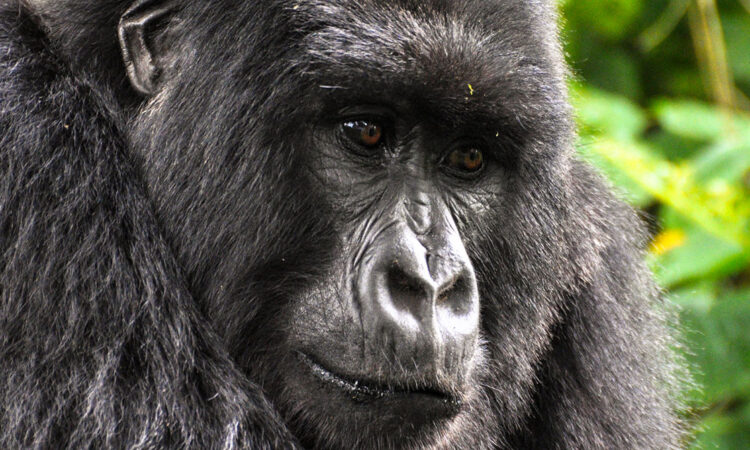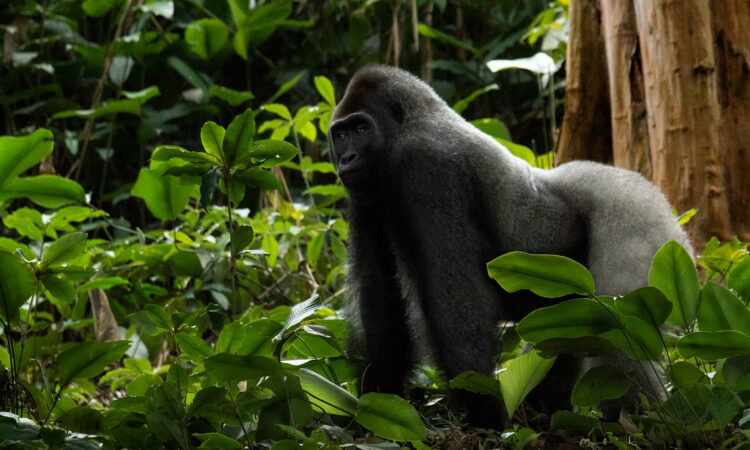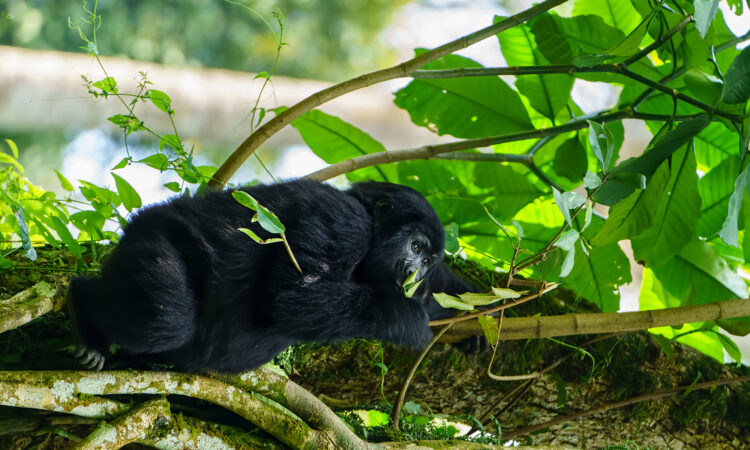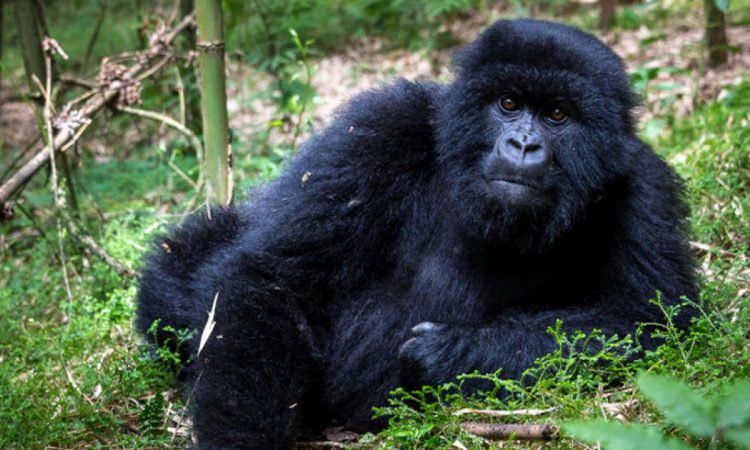
Gorillas are one of the few unique creatures in the wild with distinct behaviors but what leaves many still uncertain about these apes is, if they do drink water or not. Well, naturally, compared to other species of wildlife, gorillas do not drink water considering the fact that they feed on succulent vegetation that contains water and morning dew. As a result, they consume adequate moisture from food they eat and interestingly, they spend long hours foraging.
According to one of the journals written by Dian Fossey – world’s renowned primatologist, she noted that mountain gorillas had an obvious dislike of rain and generally, they seem to dislike water, normally trying to cross streams without getting themselves wet.
But in 2013, Jean Felix Kinani – the Rwandan Researcher spotted a gorilla drinking water in the Virunga Massif during one of the wet seasons. This was during his routine health check on Hirwa family group of Volcanoes National Park, northern Rwanda on April 16, 2013 where he saw Munyinya silverback gorilla and other family members drinking water using the back of their hand. This was unusual observation in the mountain gorillas’ daily behavior considering the fact that they attain most of their fluid from succulent vegetation that they feed on.
Hirwa gorilla family was spotted drinking in the Rwebeya Stream that runs via Volcanoes National Park in Ruhengeri, the Northern Province of Rwanda. It was till that day when Dr. Kinani was left surprised as these apes were long known not to drink water.
Gorilla diet.
Gorillas are largely vegetarians! Mountain gorillas eat over 142 plant species, 86% of which is comprised of shoots, leaves and stems. These are available within their habitat range, 2% are fruits, 2% flowers and 7% roots. The Western Lowland gorillas consume 97% of the plant species – 67% comprises of fruits, 17% are leaves and others make up 3% of their diet. The Grauer’s Gorillas eat 104 plant species with highest percentage comprising of plants.
Generally, mountain gorillas begin foraging early morning at around 6:00am and they take the long day till 6:00pm when they make new nests to retire for the night. In general, gorillas do range in higher altitudinal areas and these areas experience cold temperatures. However, they are adapted to their conditions considering their long and thick fur on their bodies. A male gorilla is capable of consuming 30kgs of vegetation in just a day and a female can feed up to 18kgs a day.
Where to go for gorilla tracking in Africa?
Trekking to see gorillas is one exciting moment that any nature lover shouldn’t miss out in Africa. It is a remarkable experience as you have a chance to meet your closest relative in the wild-that share 98% of their DNA with us. There are 2 major species of gorillas; Eastern and Western gorillas but remarkably, the 2 sub-species of Eastern gorillas are undoubtedly the most sought-after by holidaymakers on African tour. They include Eastern Lowland/Grauer’s Gorilla – these sub-species can only be trekked in Kahuzi-Biega National Park in eastern D.R. Congo.
The other notable species are rare mountain gorillas that thrive in 2 areas – Bwindi Impenetrable National Park and in the 3 Virunga Conservation Areas of Mgahinga Gorilla National Park; Rwanda’s Volcanoes National Park in the Northwestern province and D.R. Congo’s eastern based Virunga National Park.
Unlike the Eastern Lowland gorillas, mountain gorillas only remain not more than 1063 individuals world over. Trekking to see these unique apes require you to carry a valid gorilla permit, each is obtainable at $700 if you plan to visit Uganda’s Bwindi or Mgahinga Gorilla National Park; $1500 for Rwanda gorilla permits and $450 for Eastern Lowland & mountain gorilla permits in D.R. Congo.