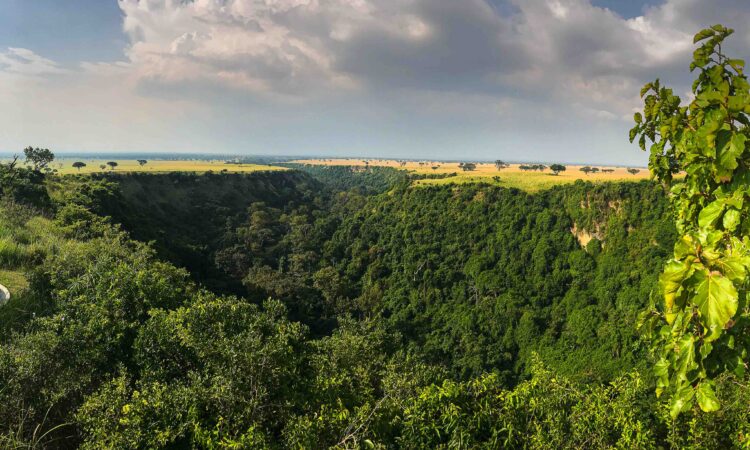
Crater Lakes are part of the magical landscapes that characterize western Uganda, coupled with the steep hillsides and verdant forests surrounding them. This makes crater lakes in Uganda habitats for birds and wildlife species in addition to being ideal retreats for cycling, walking safaris.
Formation of Uganda’s Crater Lakes.
Crater Lakes in Uganda were formed by ancient volcanic activity in the country, dating back to 8 to 10,000 years ago. Following volcanic eruptions, great damage extending across large area even more than Mount. Vesuvius happened in Pompeii. These explosions scattered the Lake Edward area into a total mess. The hot blazing fire and brimstone still exploded from these craters, as recent as 2000 BC when Egyptian Pyramids were still being constructed.
Cones were not formed as they case with Volcanoes but instead ash and rock were blown far and wide with magnificent crater lakes being formed and some still have the foul smell of Sulphur. The spectacular crater lakes in Uganda can be explored through the crater trail covering Queen Elizabeth National Park, areas near Kibale Forest National Park and foothills of Rwenzori Mountains National Park and they include;
Katwe Craters.
The Katwe Craters are found in the north of the vast Mweya Peninsula and are the most raised point of Queen Elizabeth National Park. Embarking on the 27 kilometers Crater Drive introduces you to these Craters along which several wildlife species such as Cape buffaloes, Uganda Kobs, Hippos, elephants, warthogs and Topis can be encountered.
During the crater drive, don’t miss out scenic lakes; Kitagata, Bunyampaka, Nyamunuka and Lake Katwe itself. Along this track, don’t miss out the phenomenal views of the snow-capped Mountains of the Moon, Kazinga Channel, Lakes Edward and George, the western Rift Valley and its escarpments among others. Also visit Lake Katwe and be mesmerized by the ancient salt works at the site.
Bunyaruguru Craters.
The spectacular Bunyaruguru Craters are across the Kichwamba Escarpment along the western arm of the Rift Valley, south of Lake George on the brim of Queen Elizabeth National Park. There are currently 52 Crater Lakes in the area, majority of them being dry Craters but the Africa-shaped Lake Nkugute (also Lake Rutoto) is the most stunning and is clearly visible from the Mbarara-Kasese road.
Other lakes in this area include the Twin lakes of Katinda and Murambi as well as Kamweru and Kyema, Lake Mafuro, Kibwera, Twin Lakes of Nyungu and Rwizongo, Nziranga, Kibwana, Kisanga, Kyasanduka and Nyamusingiri, Lake Nshenyi and many others.
These are not just lakes but their outstanding beauty as well as mysterious histories that will take your breath away.
Fort Portal Crater Lakes.
Among the Fort Portal Craters is Lake Kyaninga, a hidden gem with magnificent views of the Rwenzori Mountains. Staying at Kyaninga Safari Lodge rewards guests with the views of this Crater Lake and for visitors interested in hiking and cycling tours, this is the best place to visit.
Ndali-Kasenda Crater Lakes.
The Ndali-Kasenda Crater Lakes are situated on the edge of Kibale Forest National Park as well as Queen Elizabeth National Park. Some of these crater lakes are Nyabikere, the phenomenal blue-green Lake Nyinambuga, emblazoned on the country’s Shs. 20,000 note and home to olive baboons and numerous bird species, Lake Lyantonde and Lake Kifuruka. Lake Nkuruba is another jaw-dropping crater lakes, surrounded by a lush forest sheltering black and white colobus monkeys.