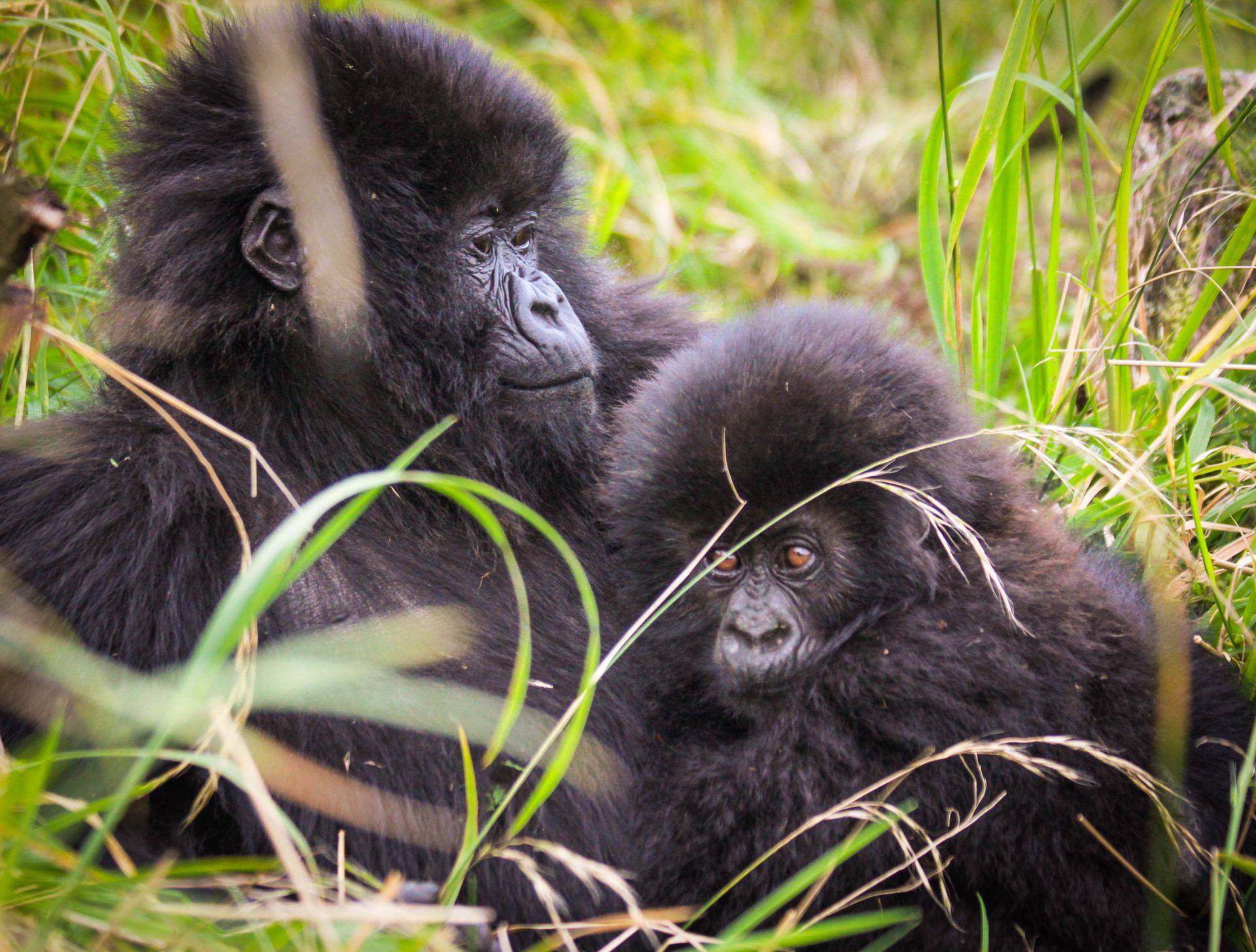
Mountain gorillas are remarkably rare and endangered primate species on planet earth, existing only in the Virunga National Park Congo, Volcanoes National Park – Northwestern Rwanda, Bwindi Impenetrable National Park and Mgahinga Gorilla National Park – Southwestern Uganda. Sharing up to about 98% of their genetic DNA, Mountain gorillas are of no doubt the closest relatives to humans after chimpanzees and the bonobos.
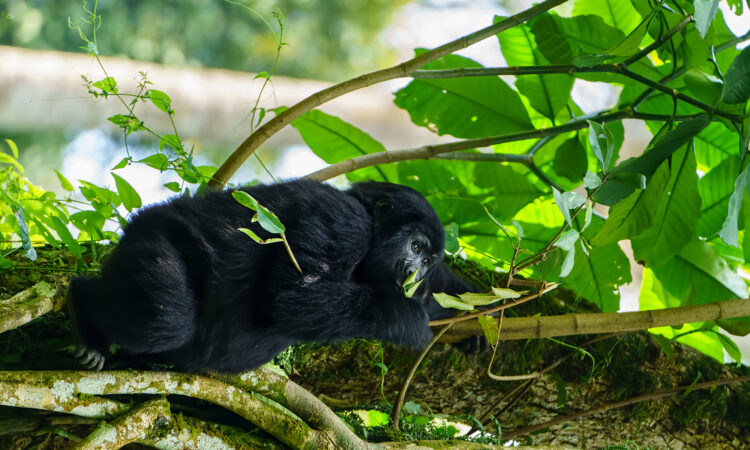
Unlike humans, the diet of mountain gorillas largely comes from vegetation. They spend most of their day foraging and the silverback – dominant leader is responsible of identifying areas or leading the rest of the gorilla family members to places with abundant food for them to feed on. These creatures can feed on over 104 plant species and most of these, are succulent and they don’t need water.
A mature male mountain gorilla/dominant male is referred to as silverback. They grow a grey patch of hair on their backs when they reach old age. Generally, mountain gorillas have a unique social structure like humans-they live in families also known as groups ranging from 5 to 40 members. In each of the mountain gorilla group family, there are females, infants, sub-adults, silverbacks and these are led by one dominant silverback gorilla.
Females have relatively weak relationship unlike when it is females and males. The silverback gorilla is in charge of the family and so he is responsible for protection of his family members. At midday, mountain gorillas relax and they usually spend this time bonding, grooming the young ones, socialize with other members especially the young ones in the group family.
Female mountain gorillas follow male mountain gorillas for mating reasons. Like humans, they (females) have a gestation period of 8 and half months, giving birth to a single infant although they are capable of giving birth to twins-this rarely occurs in the mountain gorilla habitat. Breastfeeding infants is between 3 to 4 years. Female mountain gorillas have 1 to 2 fertile days each month and they are one of the few creatures with lowest birth rate. A baby mountain gorilla can weigh up to 4 pounds once born.
New nests are built each day late in the afternoon/evening. They use the tree branches and surround them with leaves. Usually, they have 3 to 4 hours of foraging prior midday when they rest and resume the next session in the afternoon.
Mountain gorillas are generally shy but humble, gentle in nature. However, they can become aggressive if they feel insecure/disturbed. An aggressive mountain gorilla can charge at you and the signs usually include beating of the chest, tearing vegetation and hooting and grunting.
During the rainy season, mountain gorillas fear water because they don’t like getting wet. To cross water-logged areas, they usually use logs. The young ones are generally playful and, in most cases, they engage in different games. Mountain gorillas can live in the wild for up to 40 years.
Mountain gorilla permits.
Visiting Uganda, Rwanda and D.R. Congo to have an in-depth exploration about the unique mountain gorilla behaviors requires you to have a valid gorilla permit. Each of the conservation/park authorities in the 3 respective countries issue out mountain gorilla permits at their own set price-Uganda at US Dollars 700, Rwanda US dollars 1500 and DR Congo at US Dollars 450 per trekker.